Disclaimer: I perceived the idea of writing this blog for two reasons.
- Originally from the AI DEV Con 2026, Bangalore (AI summit) that I attended this year.
- After hearing the term Entity SEO for the first time from reading blogs in the SEO industry recently.

AI is getting better day by day by overcoming its own challenges.
Be it vector embeddings, vector databases, RAG (Retrieval-Augmented Generation), or knowledge graphs, models are finding ways to present better responses and more relevant information.
But how practical is it to match every terminology associated with AI development to SEO? That’s the question that came to my mind.
I started exploring the topic in depth to gain a comprehensive understanding.
I will walk you through what I learned at AI Dev Con, and also what I found on the internet about this topic.
Does Entity SEO exist?
Not sure. But entities and relationships certainly exist.
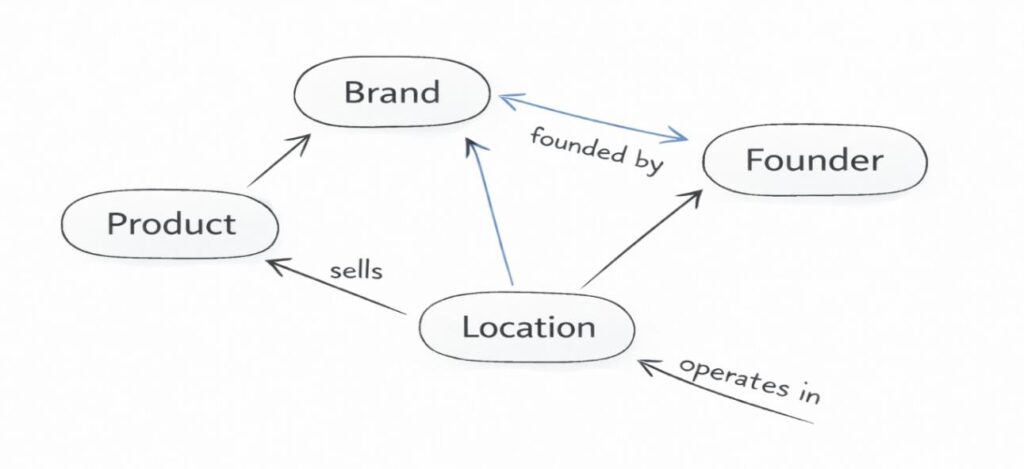
In AI, they are represented as Nodes and Edges within a knowledge graph. That’s where I believe much of the discussion around Entity SEO originate.
Nodes – entities
Edges – relationships
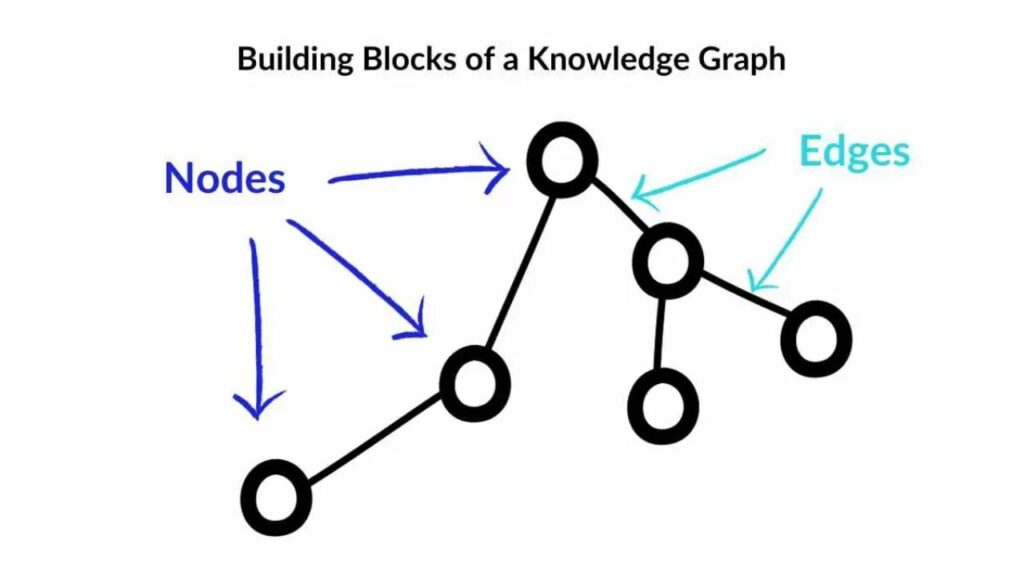
It’s a way of mapping or understanding the inherent relationships between two or more entities within a given context.
This helps bring more accuracy and relevance to AI responses and is a part of a broader framework called a knowledge graph.
This is what I learned at AI Summit.
Why Are Knowledge Graphs Used in AI Models?
Earlier, AI models were primarily trained on text data. They understand similarities through vector embeddings.
Vector embeddings are numerical representations of words and their meanings.
This is because AI models do not understand language like human beings. They rely on mathematical representations.
Example: Dog and Cat are semantically related because they are both animals and common household pets.
Let’s say Dog has its own vector representation, and Cat has another similar vector representation.
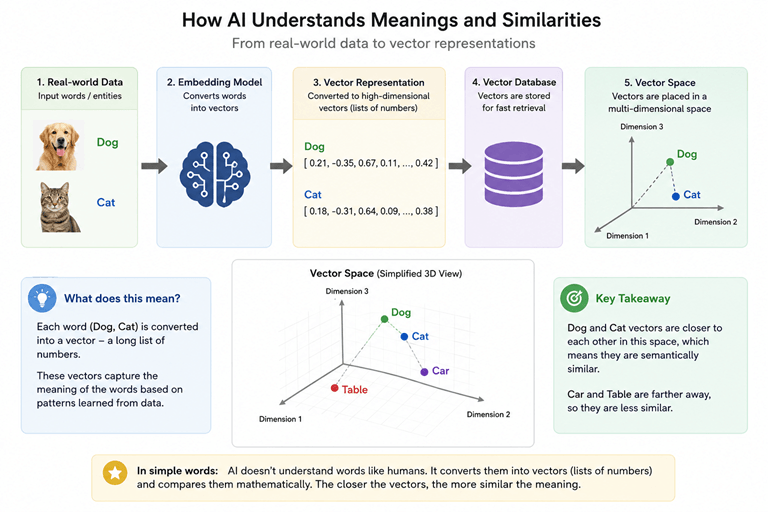
By comparing these vector representations mathematically, AI understands meanings and similarities.
But their factual knowledge is limited to what they were trained on unless connected to external sources.
Knowledge graphs help represent factual relationships between entities in a structured way, improving relevance and reasoning when used alongside AI systems.
First, AI models like ChatGPT generated responses only from their training data. Their knowledge was limited and lacked updated information.
Then came RAG, which enabled models to retrieve real-time information without retraining the model.
Knowledge graphs, on the other hand, help AI systems understand the relationships between entities, concepts, terminologies, and more.
Human-like responses + real-time information + better relevance.
What is Entity SEO meant to be?
This is what I found on the Internet – Google has launched knowledge graphs long ago (May16, 2012).
It uses structured data to map the relationships between entities.
For example, let’s say every page on a website has structured data:
- Home page –
@type: Organization - About page –
@type: AboutPage - Author page –
@type: Person - Product page –
@type: Product
The Knowledge Graph uses this structured data to understand and map the relationships between these entities, helping Google provide more accurate and relevant responses.
There is a similarity between what I learned at the AI Summit and what I found on Wikipedia. Both describe the same underlying concept for AI. It is being interpreted as Entity SEO, with knowledge graphs serving as the central concept behind it.
Conclusion
Neither Google nor other search engines have introduced the term Entity SEO as an official concept or recommended SEO framework.
Google introduced and integrated the Knowledge Graph as part of its evolution toward providing better answers rather than relying only on keywords – a shift toward understanding meaning, context, and relationships.
Like other AI systems, Google has continuously evolved by adopting new algorithms and techniques over time. Knowledge Graph is one of those long-standing advancements in that journey. Indeed it helps for a better SEO in the age of AI.
For a better understanding of how different AI models work, go through AI and SEO – Essential AI Knowledge You Need as an SEO Professional.
FAQ’s
What is Entity SEO in one sentence?
Entity SEO is the interpretation of how Google’s AI uses the Knowledge Graph to map relationships using nodes and edges.
Has Google officially announced an Entity SEO framework?
No. Google has never announced an Entity SEO framework, but it introduced the Knowledge Graph on May 16, 2012.
Is Entity SEO a proven strategy?
Proven in terms of knowledge graphs using the structured data on websites for defining relations between entities.
What’s a simple example of Entity SEO?
Using structured data on your Home, About, Author, and Contact pages helps search engines understand how those entities are connected.
How do you implement Entity SEO?
Add appropriate schema markup to your important pages so search engines can better understand your entities and their relationships.