
If you are wondering what SEOs have to do with data when content optimization is their job in the first place, the simple answer is: machines and algorithms interpret data to generate responses.
So, having firsthand knowledge of the types of data that AI and machines rely on can help SEOs organize and prepare content in a much better way.
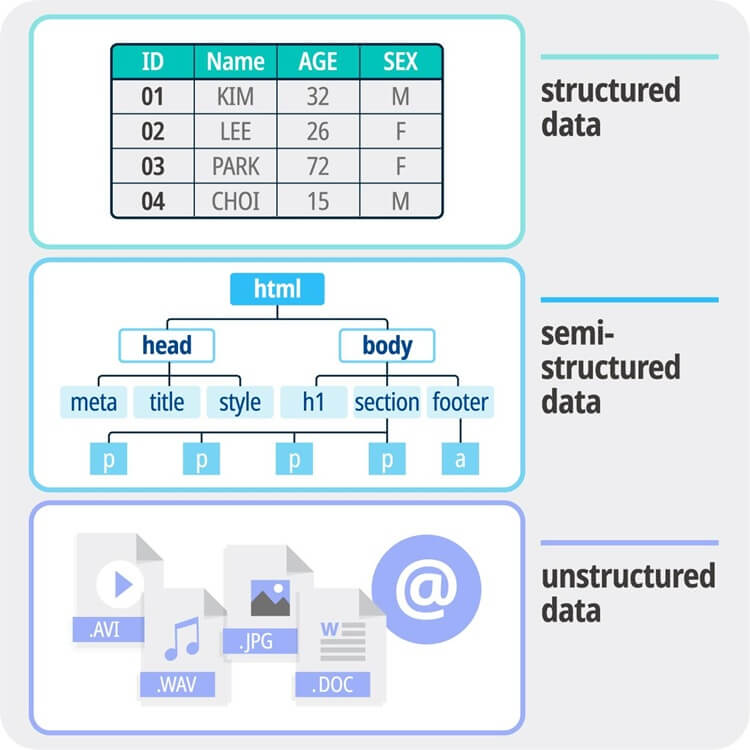
There are three common types of data:
- Structured data
- Unstructured data
- Semi-structured data
Structured Data
Structured data is data that is organized in a predefined format, so machines and algorithms can easily read, analyze, and interpret it.
Examples:
- Tables — information organized into rows and columns
- CSV files — data organized into rows and columns with predefined fields
- Relational databases — data stored in predefined tables with defined fields and relationships
They have one thing in common: the data follows a defined structure, making it easier for machines to process and analyze.
Unstructured Data
Unstructured data is data that does not follow a predefined format or data model.
It can include:
- Free-form text
- Videos
- Audio
- Images
- Documents
- Social media posts
Search engines and AI systems can process this kind of data, but it does not come neatly organized into predefined fields like structured data.
Unstructured data is commonly used in areas such as natural language processing (NLP), machine learning, analytics, and generative AI.
In some use cases, data engineers can process unstructured data to remove noise, extract useful information, and prepare it for analysis or AI applications. Data scientists can then use the processed data for tasks such as analysis, pattern identification, and predictions.
Semi-Structured Data
Semi-structured data has some structure, but it is more flexible than structured data.
In simple words, it sits somewhere between structured and unstructured data.
It doesn’t follow a rigid table-based structure, but it uses things such as tags, keys, attributes, or other markers to give the data meaning and make it easier for machines to identify and process different elements.
Examples:
- XML sitemap — uses XML tags to organize information about URLs on a website and provide search engines with additional information about those URLs.
- JSON data — uses keys and values to organize information in a machine-readable format.
- HTML — uses tags and attributes to give webpages a structure that machines can process.
For SEOs, JSON-LD with Schema.org is a particularly relevant example because it can describe entities and relationships in a machine-readable way.
Conclusion
We have been dealing with all three types of data for a very long time.
But understanding them in depth — especially why data is structured in different ways and how machines interpret it — can make our job easier and help us become more future-ready for the AI age of content preparation.
The goal isn’t for every SEO professional to become a data scientist.
It’s about understanding how machines see and process information, so we can create content with both humans and machines in mind.