

Why should you write SEO content in the first place?
If your objective is to get discovered by people through search engines, you must write SEO content.
SEO is a strategic approach to getting your webpages indexed in search engines.
SEO content means structuring your content in a way that search engines can read and index.
Search engines like Google are the places where people go to find information, SEO still matters.

A well optimized SEO blog shows up in search results as an answer to a user’s query. This is how people find answers through your content.
This is how people get to know more about you after landing on your website. It is organic traffic and inbound which is very valuable.
What does SEO content have to do with the AI Age?
Usually AI relies on its training data to give the answers.
However, there is a second scenario where AI uses web search to provide answers if the training data does not contain enough information.
Ex: – Meta AI, Perplexity AI, and Google AI Overview collects information from multiple web pages and summarize them instantly. Even ChatGPT started using web search feature since November, 2024.
Because when AI scrapes the web, it gets updated information and fresh information.
Here is the best part: whenever AI chooses the web to give answers, it doesn’t just give answers, but it also point back to the original sources (web pages, SEO content) in the form of AI citations.
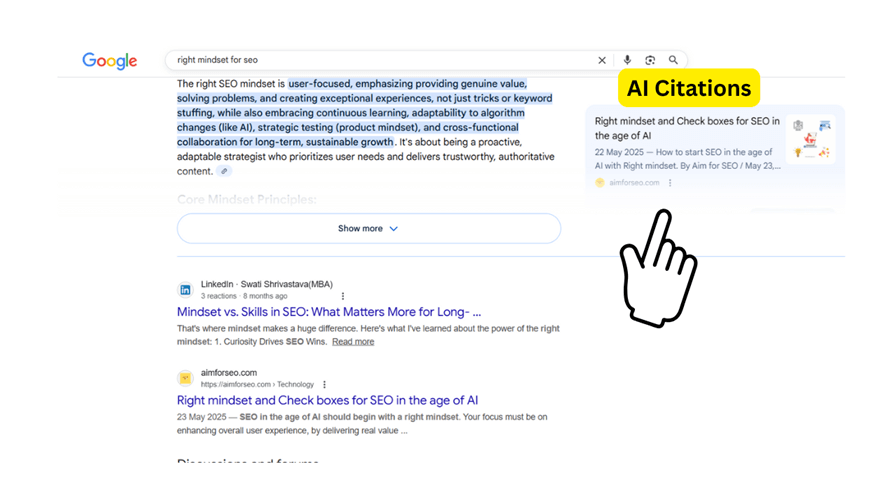
People can click those links and land on your site.
This is AI visibility which is perceived as more valuable and good for conversions.
So, foundational SEO is playing a part in AI visibility.
What should you keep in mind before writing SEO content?
Remember, there are many other writers covering the same topic as you.
So ask yourself:
Why should anyone pay attention to you?
Why should they choose your content?
If everyone is telling the same stories, why should people trust you as a reliable source?
SEO gives you the structure, but the idea must come from you.
Your content must be unique.
It should answer real questions.
It must provide insights that your competitor don’t.
Four types of Research for SEO content.
Well begun is half done. The quality of content depends primarily on the depth of research. You need to do research at four levels to make your content stand out.
Topic research
Explore the topic as much as you can. Consume content in all formats (text, image, audio, and video) for better understanding. It helps you form your own perspective.
Keyword research
Use tools like Goole keyword planner, Google trends, and AnswerThePublic.
These tools help you understand how often people search for specific keywords. They also show how a topic is gaining popularity over time.
AnswerThePublic reveals the questions audiences are asking within a niche.
Use these keywords on platforms like Reddit, Quora, and LinkedIn to see real discussions. It helps you understand the intent behind the keywords.
Competitor research
Read your competitor’s blogs. Note down their topics, meta titles, meta descriptions. Identify gaps in their content and look for opportunities where you can justify your approach:
- What insights have they missed?
- Can I add more depth or value?
- Can I tell it differently?
- Can I simplify it further?
- Can I add a real-world example?
- Can I include my own experience or story?
Data research
Data and statistics bring trustworthiness. With data, you are not just saying something, but backing it with proofs.
This helps people identify you as a reliable and credible source of information.
You can refer to sources such as Wikipedia, YouTube, archival websites, and data aggregator platforms to find reliable information and statistics.
Data reveal patterns. Data tells a story. With the right interpretation, data helps you build a strong and meaningful narrative.
How to write SEO content in AI age?
First things first – Your content must have a context, relevance, and solution.
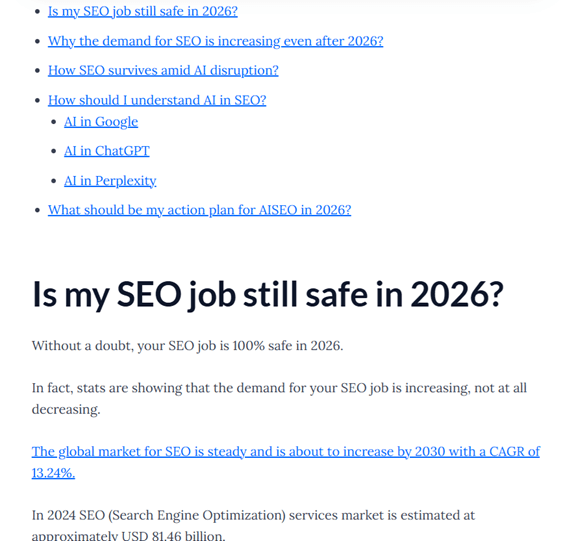
Pick one keyword and write for the intent behind it. Intent can be an emotion, pain point, fear or even an expectation.
Example:
Keyword – SEO job.
Intent – Is my SEO job safe in 2026?
Use the following framework for writing. This simple framework is suitable for the blogs that provide information.
Use – what | why | how
- What – an approach for establishing the context.
- Why – addressing a challenge.
- How – finding a solution to the problem.
- Conclusion – your final thoughts.
You can explore more depending on the depth of the topic.
Most importantly, write for humans. Don’t write for AI, and don’t write for search engines.
What else you can include in SEO writing?
SEO in the Age of AI is about multi-modality, natural language, topical authority, and context. Include these practices to elevate SEO content.
- Use headings properly – h1, h2, h3, h4 to maintain content hierarchy.
- Include FAQ’s to provide direct, concise answers for common user queries.
- Experiment with different formats like images, videos, and PDF’s to enhance engagement.
- Support your content with data and stats to build trust and credibility.
- Use schema to improve eligibility for rich results and featured snippets.
- Write in natural language and conversational tone to align with voice search.
Conclusion
AI is already good at understanding complex queries, collecting information from multiple sources and summarizing it effectively. So, don’t try to manipulate AI. Stick to the topic for contextual relevance.
See the bigger picture in SEO Strategy for AI Age.