Search has changed significantly with the rise of AI powered search vs old traditional search.
Traditional search engines have primarily worked by helping users find relevant web pages, videos, images, news, forums, maps, books, and other sources. Users search for a query, explore the results, open different pages, and find the information they need.
AI powered search vs old traditional search offers a different approach. Rather than just listing links, it understands your question, integrates sources, and provides a consolidated answer while continuing the conversation.
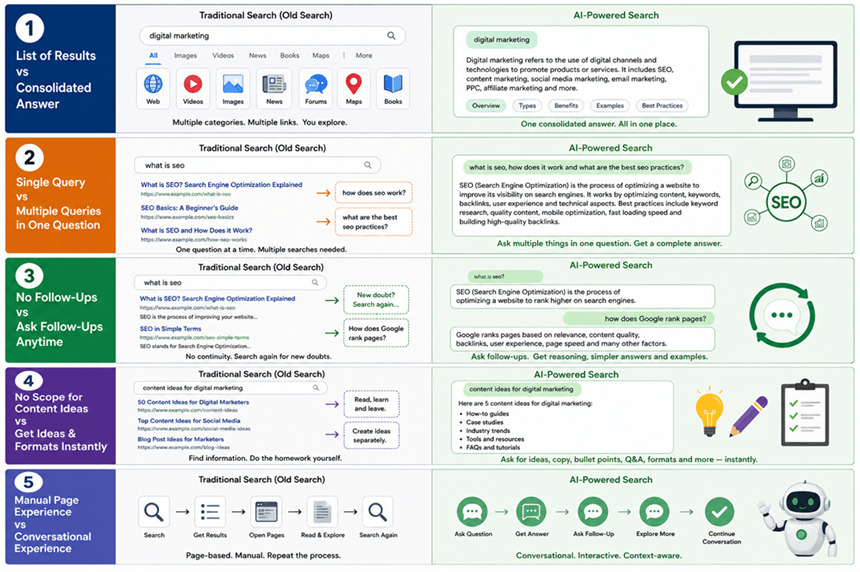
Here are five major differences between traditional search and AI-powered search.
1. From a List of Search Results to a Consolidated Answer
Traditional search provides
Provides a collection of results on a page, usually organized into different categories such as web pages, videos, images, news, forums, books, maps, and more.
For example, if you search for a topic, you may need to explore several results across different formats to collect all the information you need.
AI-powered search
Changes this experience by bringing relevant information together into one consolidated answer.
Instead of making you go through multiple categories and pages, AI-powered search can understand the query, process information from relevant sources, and present the answer in a more organized way.
The experience moves from searching through a list of results to understanding a consolidated answer.
2. From One Search Query to Multiple Queries in One Question
Traditional search
Generally works best when you search for one specific question at a time.
For example, you might search:
“What is SEO?”
After finding the answer, you may need to conduct another search:
“How does SEO work?”
Then you may need another query:
“What are the best SEO practices?”
This means you have to break down your information needs into multiple searches.
AI-powered search
Can handle multiple related queries within a single question.
For example, you can ask:
“What is SEO, how does it work, and what are the best SEO practices?”
The system can understand the different parts of the question and provide a combined response.
This makes AI-powered search more suitable for questions that require context, multiple steps, and deeper understanding.
3. From Starting a New Search to Asking Follow-Up Questions
Traditional search
It does not provide a continuous conversational experience.
If you have a new doubt while reading about a topic, you generally need to conduct another related search. You may continue exploring different queries and web pages until your questions are clarified.
For example, you may search for “what is SEO,” find an answer, and then have another question about how Google evaluates websites. You would need to perform another search for that question.
AI-powered search
With AI-powered search, you can simply ask a follow-up question within the same conversation.
You can ask for clarification, request a simpler explanation, ask for reasoning, or even ask for examples.
For example:
“Can you explain that in simpler terms?”
or
“Can you give me an example?”
The conversation can continue based on the context of the previous question.
This makes search more interactive, conversational, and context-aware.
4. From Finding Information to Generating Ideas and Content
Traditional search
It is primarily designed to help you find information.
You search for a topic, read different sources, understand the subject, and then leave the search experience to develop your own thoughts, ideas, drafts, or content.
If you want content ideas after researching a topic, you usually need to conduct additional searches or work on those ideas separately.
AI-powered search
Can take this a step further.
Within the same topic and conversation, you can ask for ideas, feed copy, bullet points, questions and answers, summaries, examples, or different content formats.
For example, after researching a topic, you could ask:
“Give me five content ideas on this topic.”
“Turn these points into a social media post.”
“Give me bullet points for this topic.”
“Create a Q&A format.”
“Give me examples to explain this concept.”
The search experience can therefore move beyond finding information to exploring ideas and creating useful outputs from that information.
5. From a Manual Page Experience to a Conversational Search Experience
Traditional search
Provides a page-based experience.
You enter a query, receive a list of results, open pages, read the information, return to the search results, and repeat the process when you need more information.
The process is largely manual.
AI-powered search
Introduces a more conversational experience.
Instead of repeatedly searching, opening different pages, and starting new queries, you can interact with the search system through a conversation.
You ask a question, receive an answer, ask a follow-up, request clarification, explore examples, and continue from the same context.
In simple terms, traditional search is largely page-based and manual, while AI-powered search is becoming more conversational and interactive.
The Search Experience Is Changing
Traditional search helps users discover and explore information across different sources and formats.
AI-powered search aims to make that experience more conversational, contextual, consolidated, and interactive.
As AI continues to become part of search, understanding these differences is important not only for users, but also for businesses, publishers, content creators, and SEO professionals adapting to the new search landscape.
You can refer to the Beginner’s SEO Guide to understand the fundamentals of SEO and how AI has changed them along the way.